

When people describe Canada as calm, they are often referring to something experiential rather than statistical.


Calm, in psychological terms, is not simply the absence of conflict. It is the presence of safety cues, environmental predictability, social trust, and access to restorative space. It is the felt sense that the nervous system does not need to remain on high alert.
From a counseling perspective, national temperament can be understood as the interaction between environment, culture, and individual perception. While no country is uniformly calm, certain structural and cultural patterns in Canada, particularly in its major cities and surrounding neighbourhoods, contribute to an experience many people interpret as emotionally regulating.
In the first half of this article, we will look at how urban design and suburban life in three major Canadian cities can support psychological calm. We will then explore the broader cultural and social factors that shape Canada’s national temperament.
Calgary: Nature-Integrated Neighbourhoods and Nervous System Regulation
Calgary is often referenced in conversations about Canadian livability, but it represents only one example of how environment influences emotional tone. What distinguishes Calgary is the integration of natural landscapes into everyday residential life.
Neighbourhoods such as Tuscany, Signal Hill, and Auburn Bay are structured around green corridors, walking paths, and proximity to parks. The Bow River pathway system runs through the city, offering accessible nature within minutes of residential areas. The Rocky Mountains are visible from many parts of the city and within easy driving distance.
From a psychological standpoint, proximity to nature is associated with reduced cortisol levels, improved mood regulation, and lower perceived stress. Exposure to green space supports what therapists often call nervous system down-regulation. The parasympathetic nervous system, responsible for rest and recovery, activates more readily in environments perceived as safe and spacious.
Suburban design in Calgary also tends to include wider streets, lower density housing compared to many global cities, and clearly defined community hubs. Reduced congestion and lower ambient noise levels diminish chronic sensory stress. For individuals prone to anxiety, environmental predictability and spatial openness can significantly influence baseline emotional tone.
Vancouver: Urban Density Balanced by Ocean and Forest
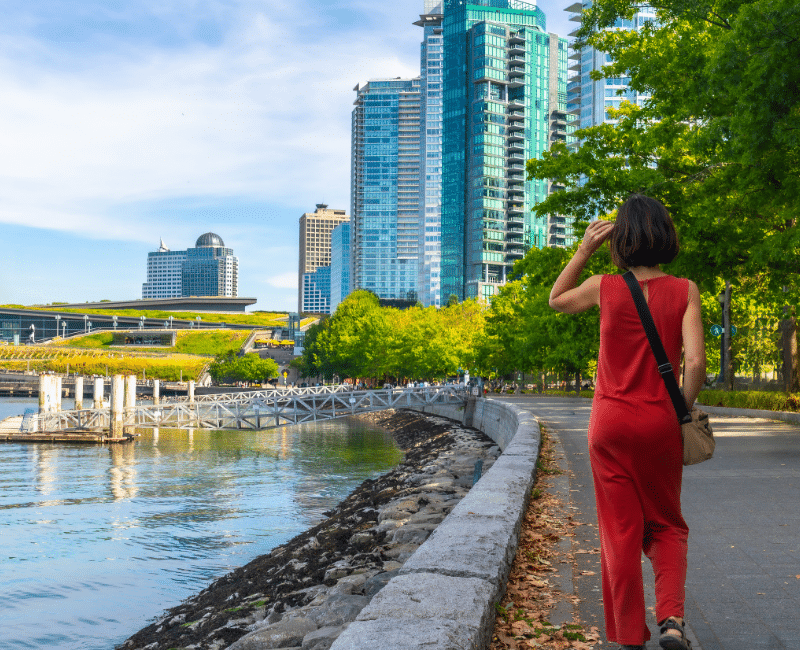
Vancouver presents a different model of calm. It is a dense metropolitan centre, yet it is bordered by ocean, beaches, and mountain forest. Neighbourhoods such as Kitsilano, Mount Pleasant, and North Vancouver combine walkable urban design with immediate access to water and trails.
From a psychological perspective, Vancouver demonstrates how natural boundaries regulate urban stress. The presence of water in particular has documented calming effects. Coastal environments encourage rhythmic sensory input, such as waves and wind, which can promote grounding and present-moment awareness.
Walkability also plays a role. When individuals can move through their neighbourhood on foot, accessing cafes, parks, and social spaces without high traffic exposure, it reduces daily friction. Lower friction environments reduce cognitive load, which in turn lowers chronic stress activation.
Vancouver’s environmental culture also emphasizes outdoor activity. Cycling, hiking, and skiing are normalized parts of daily life. Physical activity is one of the most evidence-based tools for managing anxiety and depression. When infrastructure supports regular movement, mental health outcomes improve indirectly through behavioural reinforcement.
Toronto: Structured Suburbs and Community Containment
Toronto is Canada’s largest city and arguably its most fast-paced. Yet even within a dense metropolitan region, many suburban areas foster a sense of contained calm.
Neighbourhoods such as Leaside, High Park, and parts of Etobicoke provide tree-lined streets, defined community centres, and accessible public parks. The city’s ravine system runs quietly beneath busy areas, offering pockets of unexpected green space within an urban environment.
Psychologically, Toronto illustrates the importance of containment. Containment refers to the experience of having clear boundaries and predictable structure. Even in a large city, clearly zoned residential districts and organized transit systems reduce chaos. When individuals feel they can navigate their environment confidently, the nervous system perceives lower threat.
Toronto also benefits from strong multicultural neighbourhood identities. When communities maintain distinct cultural cohesion, residents often experience increased belonging. Belonging is a protective factor in mental health, buffering against loneliness and social anxiety.
While Toronto can feel stimulating, the presence of structured suburbs and accessible parks creates emotional counterbalance.
Social Trust and Interpersonal Norms
Beyond geography, Canada’s calm reputation is influenced by interpersonal culture. While stereotypes should be approached cautiously, there is measurable evidence that Canadians tend to report relatively high levels of social trust compared to many nations.
From a counseling lens, social trust reduces hypervigilance. When individuals expect respectful interaction rather than hostility, the brain allocates fewer resources to threat detection. This does not eliminate conflict, but it shifts baseline assumptions toward safety.
Politeness norms, queueing culture, and restrained public discourse contribute to predictability in social interactions. Predictability is calming because uncertainty is one of the strongest triggers of anxiety. When daily interactions follow consistent social scripts, emotional energy is conserved.
Public Infrastructure and Psychological Security
Access to public healthcare, regulated institutions, and relatively stable governance structures also contribute to perceived calm. While no system is without flaws, social safety nets reduce catastrophic uncertainty about illness or financial ruin for many citizens.
In therapy, we often discuss external stressors. Chronic exposure to instability, whether economic or institutional, heightens anxiety and defensive behaviour. Conversely, environments where support systems are visible and accessible lower baseline stress activation.
Infrastructure such as public transit, maintained roadways, and predictable services may seem mundane, but they communicate reliability. Reliability fosters psychological security.
The Role of Space and Population Density
Canada’s overall population density is low relative to its landmass. Even in cities, many neighbourhoods offer personal space and access to outdoor areas.
Personal space is not simply a cultural preference; it influences nervous system responses. Crowding can increase irritability, vigilance, and stress. Environments where individuals can regulate proximity and retreat when needed support emotional balance.
This is particularly relevant for individuals sensitive to overstimulation. The ability to move from urban activity into quiet residential or natural areas allows for recovery cycles throughout the week.
Individual Perception and Subjective Experience
It is important to acknowledge that calm is subjective. A person with trauma history may experience even orderly environments as unpredictable. Someone facing financial hardship may not perceive structural calm at all.
National temperament is not uniform. It is a combination of macro-level conditions and micro-level interpretation. Counseling emphasizes this interplay: how we interpret our surroundings often shapes emotional outcome as much as the surroundings themselves.
However, when environmental design, social norms, and infrastructure collectively support predictability and safety, they increase the likelihood that individuals will experience calm.
What We Can Learn from Canada’s Perceived Calm
Whether or not someone lives in Canada, the psychological elements associated with its reputation are transferable.
● Integrate nature into daily routine when possible.
● Create predictable schedules and environments.
● Cultivate respectful social interactions.
● Reduce unnecessary sensory overload in living spaces.
● Prioritize community belonging.
These are therapeutic principles that align with what makes certain Canadian cities and suburbs feel emotionally steady.
Calm as a Collective Experience
Canada’s perceived calm is not accidental. It reflects urban planning choices, access to green space, cultural norms around civility, and institutional stability. In cities such as Calgary, Vancouver, and Toronto, suburban and neighbourhood design plays a significant role in shaping daily emotional experience.
From a psychological perspective, calm emerges when environments signal safety to the nervous system. When individuals feel safe, predictable routines develop. When routines stabilize, emotional regulation improves.
While no country is immune to stress or conflict, understanding how place influences mental health empowers individuals to intentionally shape their own environments toward greater calm, wherever they reside.